
What Goes Under Artificial Grass in Oakville?
A synthetic lawn is only as good as what sits beneath it. When people ask what goes under artificial grass in Oakville, they are really asking why one lawn stays flat and drains for a decade while another ripples and puddles within a year. The answer is the base. On the heavy clay that runs under most of Halton, the layers below the turf do the heavy lifting, and getting them right is where Artificial Grass Oakville spends most of the install.
What goes under artificial grass?
From the ground up, a proper turf lawn is a stack of layers, each with a job:
- Sub-grade: the native soil, excavated down and graded to the right slope. In Oakville this is usually clay.
- Geotextile weed barrier: a permeable fabric that blocks weeds from below while letting water pass.
- Crushed stone base: compacted angular stone, often a granular A or a 19 mm crush, that provides the structural, free-draining foundation.
- Bedding layer: a thin layer of finer stone dust or sand, screeded smooth so the turf sits level.
- Turf: the synthetic grass itself, rolled out, seamed and secured.
- Infill: sand or a coated sand brushed into the fibres from the top to weigh the lawn down and hold the blades upright.
Skip or thin out any one of these and the lawn suffers. The stone base is the part that separates a lasting install from a cheap one.
How we install it, step by step
1. Excavation
We strip the existing lawn or surface and dig down, typically 100 mm or more for a residential lawn. The dig sets the finished height so the turf meets your patio, walkway or driveway cleanly rather than sitting proud of it.
2. Grading and the weed barrier
The exposed sub-grade is shaped to fall away from the house and any structures so water has somewhere to go. Then the geotextile fabric goes down to keep weeds out and separate the clay from the clean stone above.
3. Building and compacting the base
Crushed stone is spread in layers and compacted with a plate tamper, checking the slope as we go. Compaction is what stops the ripples and dips that show up later. A properly packed base on Oakville clay is the difference between a lawn that drains and one that holds a puddle after every storm off the lake.
4. Bedding and laying the turf
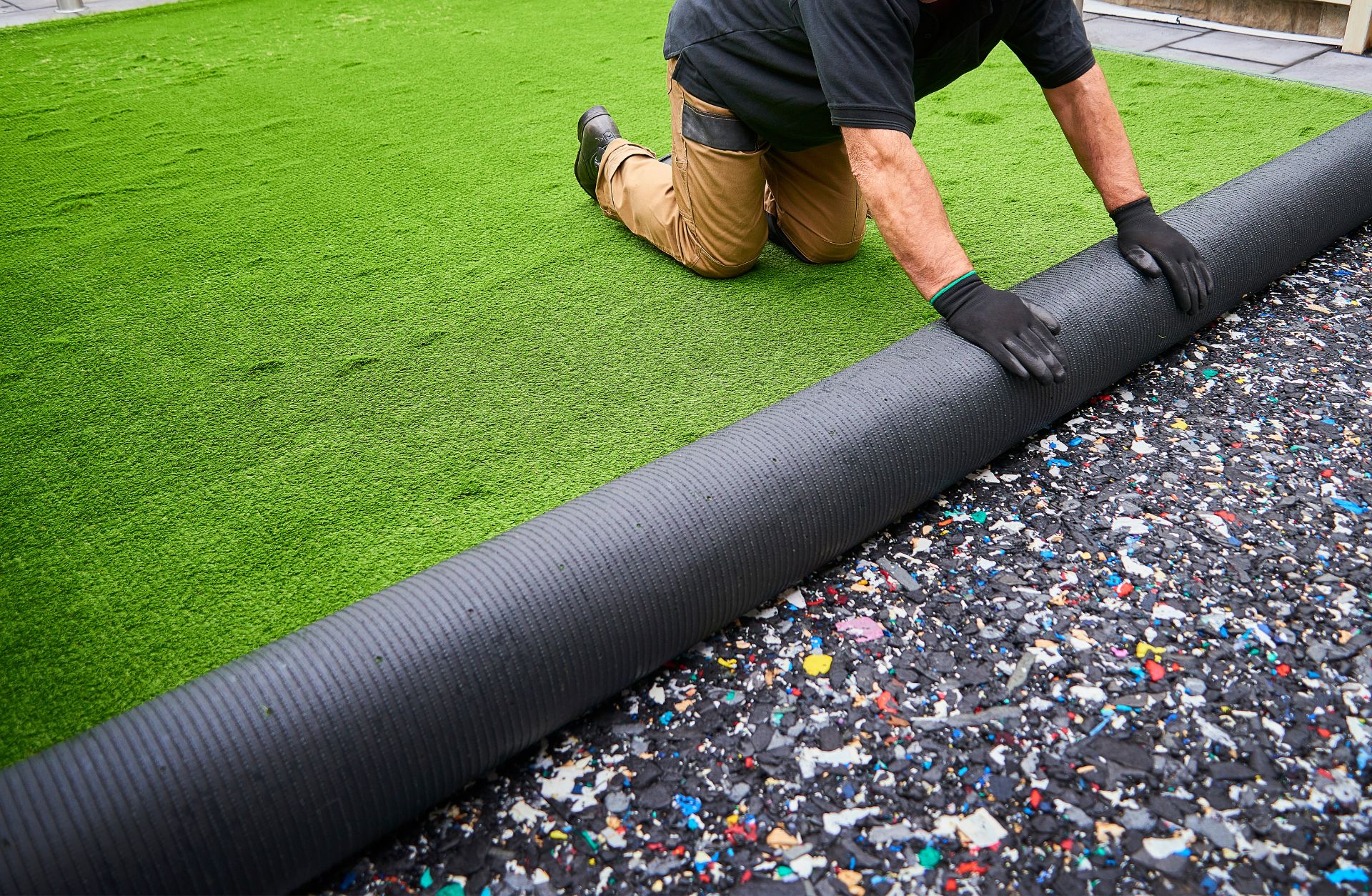
A fine top layer is screeded dead flat, then the turf is rolled out and left to relax so the backing settles and the blades stand. We orient every piece the same direction so the lawn reads as one continuous surface.
5. Seaming and securing
Where two pieces meet, they are joined with seaming tape and adhesive for an invisible join, then the whole perimeter is fixed with landscape nails into the compacted base so nothing lifts at the edges.
6. Infill and finishing
Finally, infill is brushed into the fibres in passes. This adds ballast, protects the backing, and keeps the blades upright underfoot. A power broom finishes the surface so it stands tall, and we clean up and walk you through the care routine.
Why Halton clay changes the base
Sandy soil drains on its own. Oakville clay does not, so the base has to compensate. That usually means a deeper stone layer and careful attention to slope, because if water cannot get through the clay it must be carried away sideways through the stone instead. This is the most common reason a proper Oakville quote costs a little more than a bargain one, and it is the part you cannot see once the turf is down. It matters just as much on a smooth putting green, where any dip in the base shows up in the roll of the ball.
Installing over concrete and hard surfaces
Not every project is dug into soil. Around Bronte and the older lakeside streets, we often lay turf over an existing concrete patio, a rooftop terrace or a pool deck. In that case we skip the stone base and instead add a shock pad or a thin drainage mat, then glue the turf directly to the slab. The one requirement is that the concrete drains or slopes, so water is never trapped between the slab and the backing.
Frequently asked questions
How deep is the base under artificial grass?
In Oakville the compacted stone base is usually 75 to 100 mm deep for a lawn, and deeper for driveways or heavy-use areas. Halton clay often calls for the upper end of that range so water drains away properly.
Do you need a weed barrier under turf?
Yes. A geotextile weed barrier sits between the sub-grade and the stone base to stop weeds pushing through while still letting water drain, which keeps the lawn clean for years.
Can artificial grass go over existing concrete?
It can. On a sound concrete patio or pool deck we add a shock pad or a thin drainage layer, then glue the turf down. The slab needs to drain or slope so water is not trapped underneath.
Want the Base Done Right?
The base is everything, and we build it for Oakville soil. Call (289) 815-3105 or request a free quote and we will assess your site in person.
Get a Free Quote